Encounter
A Stack of Pancakes & A Side of Revenge With Niko Rubio
Niko Rubio is finally taking top billing. Her alter ego has a few scores to settle.
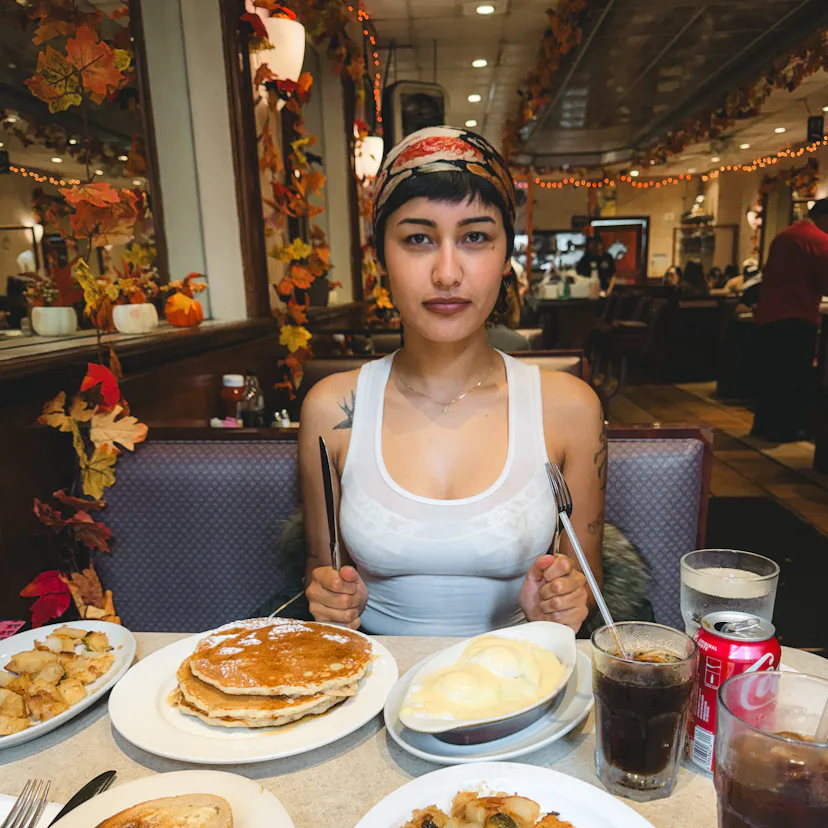

Niko Rubio is ready to dive in. It’s just past 10 a.m. on a chilly November Friday when the singer bounds into Midtown Manhattan’s Morning Star Cafe. Outside, the skies are a cloudless blue; inside, a morning crowd of camera-toting tourists and Midtown suits tuck into eggs and bottomless coffee. The pop star unzips her puffer coat while sliding across the cherry red leather of our corner booth. “I don’t really know a meal without sharing,” she says as we debate the menu. She eventually lands on a sweet-and-salty combo: eggs Benedict for her, pancakes for the table, washed down with an ice-cold Coca-Cola. “Having a Coke for breakfast [is] the most Mexican thing about me,” she laughs.
It’s not that she needed the caffeine. The bubbly Angeleno barely misses a beat, pouring maple syrup while chatting through her dream-scenario fast-food collaboration (“Jersey Mike’s: a Number 7, turkey prov’, Mike's way, add mayo, mustard, pepperoncinis, jalapeños.”). She runs me through the schedule for her latest trip to New York, which included a 10-hour video shoot yesterday and will conclude with a visit to a Chinatown for dumplings this afternoon before heading to Las Vegas for the Latin Grammys (a ceremony at which she’d go on to win Best Rock Song for her songwriting contributions to The Warning’s “Ego”).
“Last year, I couldn't pay my rent,” she says. “This year, I'm like, ‘OK, now we’ve got to plan a U.K. tour.’”

“Tokyo,” the unlikely breakout from her first studio album, late night swim, released Oct. 30, has been doing numbers online, introducing her to a wave of new listeners and pushing her past the million-monthly-listener mark on Spotify. The song’s success has been something of a surprise, even to her. With its 45-second spoken-word intro and moody trip-hop beat, it wasn’t exactly built like an obvious pop hit. “There's no reason for this song to be my biggest song,” she says. “It doesn't make any sense.” Its sensual charm was originally conceived as an introduction to the spy-girl-themed world she’d spent months building via a Pinterest board of lush blue hues, Madonna’s Bedtime Stories, ‘90s English electronic band Sneaker Pimps, and cinematic shots of water. “She's a spy, but she's undercover as a hot LA socialite [who] uses all these men that she has,” Rubio says of her album’s femme-fatale alter ego; the album’s title, meanwhile, was written in the stars. “I'm not a bed girl necessarily. I'm a Pisces. So I was like, ‘Late Night Swim, duh.’”
Her commitment to the bit was borderline method: Rubio put pen to paper, writing a full manifesto detailing her character’s vengeful motivations, lover-scorned backstory, and general modus operandi narrated across the 10 tracks. The character has since taken on a life of her own. After “Tokyo” began picking up steam, Rubio has been making some wide-ranging rounds, from a stop on Heds.World’s carRADIO to a performance at the Grammy Museum, where she took on both “Tokyo” and Madonna’s “Material Girl.” Not bad for a girl who was once more comfortable writing the hit than being the one singing it.


Rubio’s no newcomer to the music industry — in fact, she’s nearly seven years into a recording contract — but she’s just settling into center stage herself. She spent the former half of her contract honing her chops as a lyricist for alt-pop heavyweights like Gwen Stefani and The Veronicas, often pitching her best songs to other artists in the hopes that one might become a hit. “I cared more about breaking another artist than I cared about breaking myself because I cared so much about proving myself as a writer,” she says. “I never felt like I was pretty and I was always very afraid of people seeing me online. I used to be twiddling my fingers being like, ‘Is anyone ever going to care?’ and then I was like, ‘I think you just need to care.’”
While many early-20-somethings are off at college discovering themselves, Rubio, who signed to Atlantic Records at 19, had other plans. The Mexican-Salvadoran singer decamped to Mexico City, recording two albums in Spanish, experiencing her own sort of “college years” and fine-tuning her Latin pop sound. “Sometimes it's OK to fall off the face of the Earth for four years. Sometimes it's important to go to graduate school and not talk to your friends,” she proselytizes. “And that's what making projects in Spanish was for me. That's what going to Mexico City [and] what writing for Gwen Stefani was. That was me going to school.”
“Last year, I couldn’t pay my rent. This year, I'm like, ‘OK, now we’ve got to plan a U.K. tour.’”
Like any good student, Rubio studied abroad. During trips to London to visit her British boyfriend, she spent her days poking around vinyl shops and falling deeper into a reggae rabbit hole, including trip-hop and its roots in the sounds that traveled from Jamaica to Bristol. “I re-found my love for Portishead,” she says. She also found an unexpected champion in Zuri Marley, daughter of Ziggy Marley, after the two connected through a collaboration and became fast friends. “I was like, ‘F*ck. It’s either the Marleys are going to hate the fact that I’m a little Mexican girl making reggae music or they’re going to love it.’” Happily, it was the latter, and Marley ushered Rubio into her family’s orbit. “When you do it right and we know that it’s from the heart, we f*ck with it crazy,” she recalls of Marley’s encouragement.
But as with all good things, it came to an end: after Rubio returned from her first headline tour, she was dumped by the Brit — but had a new reason to make the record she’d been imagining.
“How do I make this an ode to my relationship without ever having to mention his name or the relationship itself?” she says. “I’m a yearner, I’m not a sh*t-talker. But you will know that I did that British accent on the song and that’s my ‘f*ck you’ verse.”


Heartbreak also gave Rubio a deadline. “This time, I was like, ‘You got to stop thinking this way. You deserve to be the first option, girl,’” she explains of her change of mindset. “I’m not spending a year writing songs and then sitting on them anymore when I’m in my prime years of life.” She gave herself one month to write late night swim, with a second to finish it, enlisting a tight-knit crew of longtime collaborators, including co-writer Olivia Bond, and a handful of trusted producers. She came armed with a clear brief and a playlist of trip-hop touchstones, from Portishead and Massive Attack to Thievery Corporation and Morcheeba, then filmed every studio session from three angles. The third song they wrote was “Tokyo.” “I had no time,” she says. “I didn't put any time between me making that song and showing it to the world because I didn't think about anyone but myself.”
As with any “overnight success,” the come-up had been a years-long journey. “You have to be OK with the fact that you're going to consistently work and see no results for maybe a year to two years, and then one day something works,” she says. “I realized that I could sell out [shows in] New York and Chicago. What was I so afraid of? The people are here. I have waited five years to do this. That's crazy.”
Turns out, she's in good company when it comes to taking the long way around. Rubio references Adéla, who trained for five years at a dance academy before finding her footing as a pop artist. She recounts a run-in backstage with the “Nicole Kidman” singer at Portola, reaching across the table to grab my hands to reenact the moment. “She’s like, ‘I listen to Tokyo every single day.’ And I’m like, ‘Thank you. I love you.’”

Rubio does keep tabs on the fanfare surrounding her newfound universe, particularly the fans who’ve taken it upon themselves to dissect late night swim, tracing its bass lines and reggae influences and connecting the dots between tracks. “My fans are real music lovers,” she says. “They understand the facets of these genres and why they matter just as much as I do.” Yes, she’s seen the full-blown dissertations. “Smart little f*cks.”
The spy-girl mission, meanwhile, is far from over. Rubio is already dreaming up the next installment of the universe, teasing a femme-fatale follow-up that’s “way darker” and “way sexier.” “She's gone to so many more places, she's stolen so many more jewels. We're not leaving this world for a while… When it stops being fun, I'll stop.”
