Nylon Nights
A Night At the Opera With Dua Lipa and Abraham Lincoln
Inside the opening night of the Metropolitan Opera's new production "Lincoln in the Bardo."
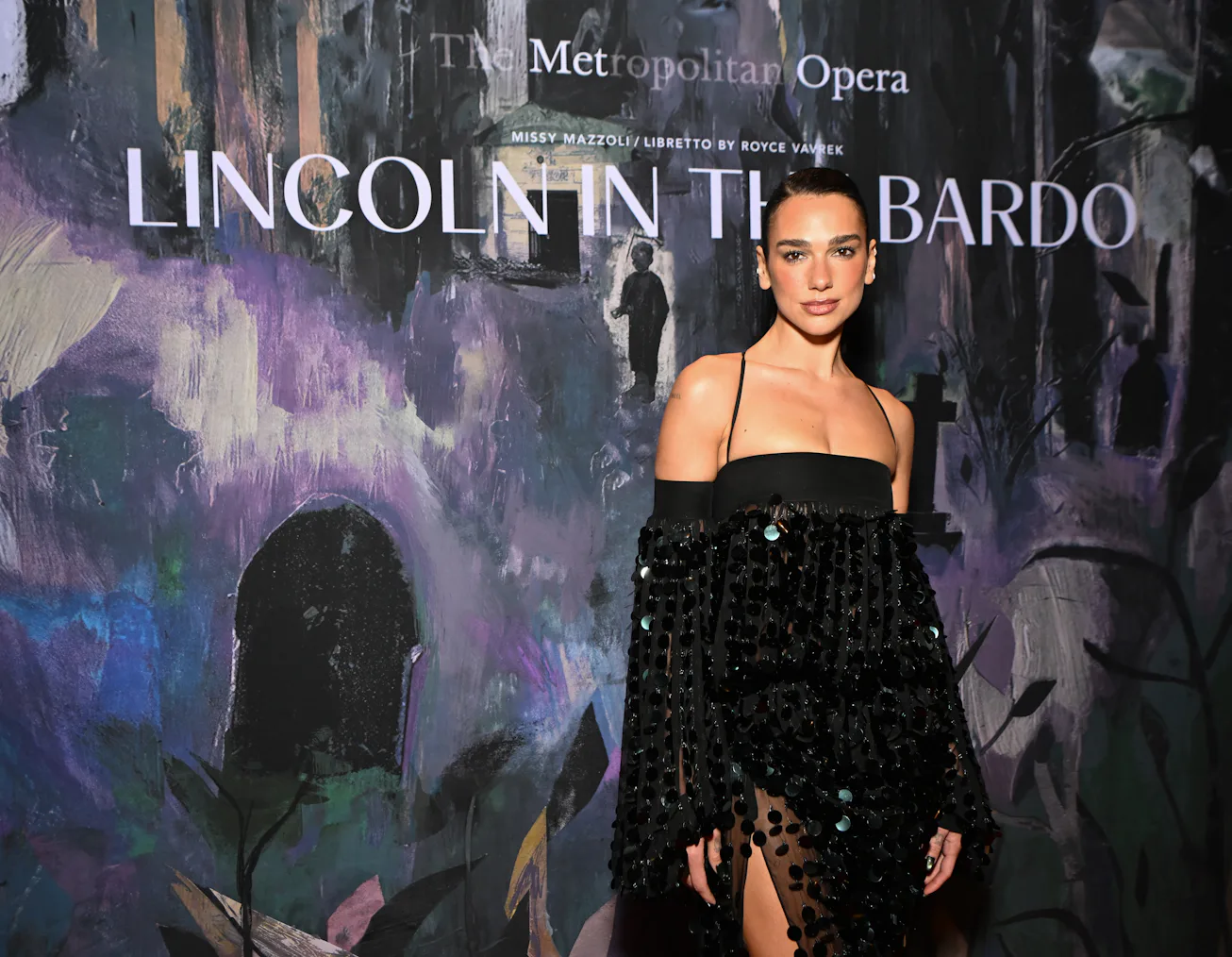
The people milling around Lincoln Center on Monday night were dressed in their early autumn best: new boots being broken in; the lightest of puffer jackets brought out of storage. Then, ushered in with a flash of camera lights, came Dua Lipa, making her way across the plaza in a shimmering gown covered in black sequin paillettes, her train bunched in one arm and husband Callum Turner on the other. Look closer, and you’d see that quite a few people were also in black tie on early Monday evening — but Lipa was likely the only one in fresh-off-the-runway Ferragamo.
Lipa, along with stars like Bowen Yang, Amy Poehler, and Dev Hynes, was out and about for a night at the opera; specifically, a pre-performance gala dinner ahead of the sold-out world premiere of Lincoln in the Bardo. With a prompt curtain time of 8 p.m., dinner was called for the very reasonable hour of 6:30 p.m. After some delays on the Williamsburg Bridge, I made my way up to the Mercedes T. Bass Grand Tier balcony at 6:32 p.m., bumping into Yang and podcast co-host Matt Rogers on my way to my table (and immediately inquiring where they had acquired their martinis, having missed cocktail hour myself). Lipa and Turner were already seated — a prompt pop star, and one who was also on duty.
The opera is an adaptation of George Saunders’s award-winning 2017 novel of the same name, which takes a supernatural approach to grief, examining the death of Abraham Lincoln’s son Willie and the events surrounding his passing. Lipa, who sat next to Saunders throughout the evening, selected the novel as Service95’s Book of the Month in 2024; two years later, the selection came full circle as the platform created a behind-the-scenes mini-documentary exploring the adaptation of the novel into an opera, which premiered on the Service95 YouTube channel alongside the show’s debut.
At the helm of the adaptation was composer Missy Mazzoli, who became the first woman to have a world premiere at the Met. Ahead of Monday’s gala, we spoke with Mazzoli about the process behind bringing an opera to life.
What was your first step in adapting the book?
We first had to get George Saunders’s permission to adapt the book, so we emailed him out of the blue. He had the best response: “I’m so glad you wrote me, because when I wrote this novel, I imagined it as an opera.” In opera, the words usually come first, so once the permission was secured my collaborator Royce Vavrek wrote the libretto. This took years, since there were a lot of decisions to be made about which characters to cut, and which to amplify or expand. There are 166 characters in the novel, so we had to make some tough decisions about which to leave out.
How did you incorporate the period of the novel with more modern elements?
There aren’t too many elements that are clearly anachronistic; I think the novel and the opera really do adhere to the 1860s. That said, George’s writing is so modern and singular, and I hope you could say the same about my music and the work of all the designers in the show, so the overall feeling of the work is not tied to any particular era. The harmonies in the work, for example, are rooted in classical music, but are chords I invented to tell this story. Likewise, the costumes, by Montana Levi Blanco, are based in accurate period costumes of the time but are distressed, exaggerated, and lined with modern colors and fabrics to create a look that is unmoored from any particular century.
How are the supernatural and otherworldly aspects of the book interpreted in the music?
There are some fun musical effects in the score that feel very ghostly to me, like the use of kazoos in the overture (played by 65 chorus members!), very high writing for the strings, use of organ and celesta, and unusual percussion instruments like the waterphone. But I tried to imbue all of the music with a haunted, unsettled vibe, by altering certain notes of the harmony, or layering particular harmonies on top of each other in a way that to me sounds a bit unstable.
What other books would you like to see become operas next?
I actually think reality TV might be the next frontier in operatic adaptations! Catfish, Real Housewives, the Elizabeth Holmes documentary — these scenarios feel like contemporary versions of Verdi or Puccini opera plots.
Dua Lipa is involved in this evening, so whose pop oeuvre would you like to see translate to opera?
My favorite aspects of opera are its surreality, its passion, and this paradox at the heart of the genre: the way it gets to the core of our shared human experience by taking live theater and the human voice to an extreme. There are so many pop stars who I feel do the same: Lady Gaga, Rosalia, Doechii, Janelle Monae, FKA Twigs… all of these women are thinking theatrically, and are using song, video and theater to tell elaborate stories about what it means to be alive right now. Opera at its best does this too.
