Entertainment
Structureless Rhythms & Batsh*t Ideas: Amanda Seyfried & Thomasin McKenzie Discuss Their New Film
A required supplement to your Testament of Ann Lee viewing.
When we meet with Amanda Seyfried and Thomasin McKenzie, stars of the new film The Testament of Ann Lee, over Zoom, it’s immediately evident that the actors are obssessed with process. “I have a feeling you’re going to take this,” McKenzie tells her co-star, which Seyfried co-signs with an affectionate mimic of herself chatting.
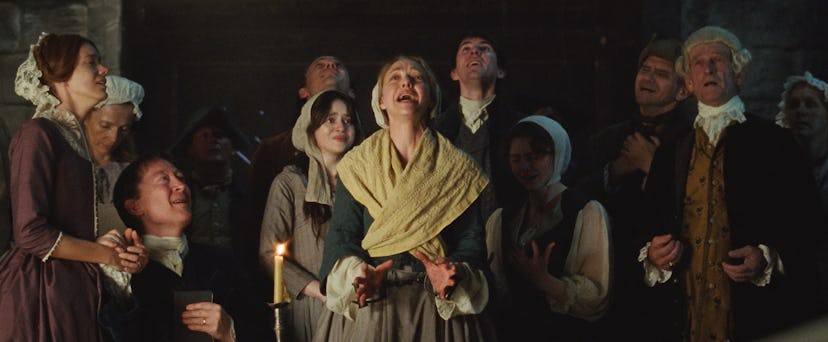
Directed by Mona Fastvold and written by Fastvold and Brady Corbet, the film tells the forgotten story of Ann Lee (played by Seyfried), who made waves in the 18th century for founding a Christian sect of religion based on gender equality, celibacy, pacifism, and ecstatic worship, known as the Shaker movement. The film has already racked up a slew of award nominations in the lead up to its Dec. 25 release, including a Golden Globe nod for Seyfried in the Best Actress in a Motion Picture: Musical or Comedy category. But Ann Lee isn’t your typical musical by any means, as the feature’s utilization of dissonant Shaker hymns and rapturous, free-flowing choreography are all in service to Lee’s inspiring — and oftentimes, relentlessly cruel — life story.
Here, Seyfried and McKenzie sit down for NYLON to talk about how their respective involvements with the film came to pass, the process of making the unconventional project, and the sizzle reel that started it all.
Thomasin McKenzie: Amanda?
Amanda Seyfried: Yes.
TM: How did you come to be a part of Ann Lee?
AS: I was talking to Mona Fastvold, the director, and she was telling me about this incredible woman who existed in the 18th century who led the Shaker movement. I was so curious about her because I didn’t understand why I didn’t know about her. And she said, “This is my project. This is what I’m devoting my life to right now, is telling her story. Would you like to read the script?” I said, “Yes, Mona, I would.” I read it and I was very confused, because all those hymns and all the movement in the script, I didn’t know what they looked like, and I didn’t know how they sounded. So I was just confused, but curious.
I tried to get Mona to picture different people to play Ann Lee, because I didn’t feel like I was quite right for it, and it felt really hard. Then she was like, “I think that you can do this.” And I was like, “OK.” It’s like that one thing where one person that you trust tells you that you should trust yourself and you're like, “OK, then I have a choice to make. Am I going to trust myself or throw away an opportunity?” So I took it.
TM: Thank gosh.
AS: [Mona] gets what she wants. She’s convincing. What was your first conversation with her? Because you were supposed to work with her on something else.
TM: She had come to me with a script a year or two before Ann Lee came about, and unfortunately we struggled to get financing, so it didn’t happen. But then, she sent through the script, and she also sent a sizzle reel along with it where you guys had already filmed a couple of the songs and dances, and she put that together and sent it to me. I watched that, and I didn’t even need to read the script. I was like, “I’m sold.” But I can imagine that if I’d read the script by itself without having watched that sizzle reel, I too would’ve been confused because it’s hard to imagine how the dancing and singing could have been incorporated into [it].
AS: It goes a long way in explaining her vision, because the script is so unique. I know Mona says that this is the most linear script that they’ve written, but I actually don’t agree with... Linear maybe, but... It’s not a structure that most scripts have. It is cradle to grave, but that’s about it.
TM: I think a lot of people have said there is no genre to put this film in. It is a genre in itself. It’s its own thing.
AS: It’s an experience. And yeah, it’s a film, beautiful film, but it’s also an experience of a particular perspective of a journey. And Mona and Brady [Corbet] wrote a beautiful script, but it still didn’t make as much sense as when we were there.


TM: When did you first realize, or come to understand, what it was that Mona was making?
AS: I think it was when we were shooting that sizzle. When I was in the room in the costume, when I was in the back, with Shannon Woodward, of a horse and carriage, with blood all over my face, in that small weekend that we did so much in, I think I finally understood the look of it, the feel of it, especially when she put the music behind the sizzle reel, and had Imogen Poots do the narration, because that’s her voice.
TM: Was it?
AS: Yeah. I was in it, doing the shoot, and I understood that this is the world we were living in and this is how we were going to capture it. And then, when I saw the actual teaser cut together a couple weeks later, I was like, “Oh, my God, you’re brilliant.” So maybe it was that moment that brought everybody together. Sometimes the vision is just so batsh*t as an idea, that you have to provide the vision. That makes it even more delicious that we got to actually make it.
TM: I really chime with what you’re saying. I’ve struggled in the past being a part of making films, when I haven’t fully understood what it is that the director wants to make. So I’ve learned just to ask “What are we making here? What are you envisioning?” Because you need to be on board with each other. You need to be on the same page. Otherwise you’re just going to have conflicting ideas.
AS: And then you don’t know what’s needed of you. If you don’t know what’s needed of you, you can’t provide it. You’re constantly questioning your own choices. That’s why I think we are in the very, very lucky and happy position of being able to choose projects based on clear vision from the director. These incredible directors with the clear vision do exist, and they stop at nothing to get it made. Indie filmmaking is rough. But if you’re willing to go through it, it’s because you have a story to tell and you’ve got to tell it.
TM: Tell me about the collaboration between you and Mona and Daniel [Blumberg] in achieving the music that we hear throughout the film. Did they know exactly what it was that they wanted, and you just did that? Or did you have much input in what Ann Lee and what the overall sound of the film was?
AS: I think because Daniel Blumberg has such a very specific sound and a very specific rhythm, he really marches to the beat of his own drum, literally. Sometimes, I just can’t catch up. So, a lot of it was like, “Where do you want me to be? How do you want me to do this?” And he would always respond with “Well, what key do you want to sing this in? Let’s find the key that’s right for you.”
So it was a true collaboration in that he was trying to find what would work best for me, Amanda, as a vocalist. And then, when it came to the music, there was no space. I didn’t want to create space for my own input, because I just trust Daniel, and I trust Mona, that when they need something from me, they’re going to ask for it very, very directly. And I just want to provide what they need, and that fulfills me.
But, it was like once we found the key, even if it was a cappella, then we flew with that. And Daniel, he has his ways of operating, but there was always space for me to be like, “You know what? Actually, maybe I could change my mind about certain keys.” And it just felt really safe.
TM: It wasn’t like you weren’t trapped.
AS: I wasn’t ever trapped, but I also just wanted to be guided through it, because I don’t write music. I perform it. If I can pick my own note that feels safer for movement, because I’m going to be dancing through a lot of it, then I will. And they were so respectful of that. But it really was most of the time just getting on the train, sitting in my seat, and going along for the ride. And I learned so much about myself as a musician. I learned so much about music, learned so much about percussion, and that it ... doesn’t [necessarily] stay on the same rhythm. Didn’t you find that the rhythm is just not... I feel Daniel’s rhythm can sometimes get lost.
TM: Yeah. It’s unstructured. His rhythm doesn't have much structure.
AS: Yeah, no sheet music, by the way.
TM: No, none at all. He would be writing it on the day. I remember I did a few singing lessons before we started filming, and the singing teacher kept asking for some sheet music. She kept asking for a key, and I was kind of like, “I don’t know.” But Daniel was very generous in that he really wanted to find your own sound. It wasn’t about putting you into a box, [like] “you’re alto” or “you’re bass.” He wanted you to discover the sound that you felt most represented you or the character, which was great because I find singing very intimidating, and I’m not a trained singer at all. So being able to find a sound that I felt comfortable in, and a key that I felt comfortable in, was really helpful. But for you, even though the film is complete, you and Daniel and Mona haven’t stopped collaborating, making music. You’ve literally just come out with another piece.
AS: I know. I think [Daniel] wanted to create some original music within the movie. At first, I think everybody’s a bit intimidated by that, because we were using real Shaker hymns that were written back from the 18th century on, and they’re beautiful, but they’re very simple. And he needed to create a world around it, and the world needed to flow in and out of these scenes, and it needed to feel cohesive and musical, but not too musical. It needed to feel organic. That was a huge mountain for him to climb.
For [Daniel] as a musician, I think he learned as much as we did as movers. We are all human beings, and we were representing human beings. We’re not representing people who were training to dance in the 18th century or taking singing lessons in the 18th century. These are human beings that needed to move and sing their way through worship, because their lives depended on it. And so, the fact that you and Lewis [Pullman] specifically were not trained singers, it made it all more impactful. I had to unlearn a little bit, and stop listening to myself with that kind of judgment that I had, as a trained singer, who still never got where she wanted to go, but now I’m just like, “I’m absolutely perfectly where I am.”


TM: There’s a good point that I don’t think Daniel had done a job before where he had to take dance into consideration when writing music, and when writing lyrics. Singing is one thing; dancing is another thing. Singing and dancing together is a whole other story. And luckily, we weren’t singing live. We had the backtrack, but we still had to have the breath in order to like...
AS: Thank God we didn’t have to sing live on the boat stuff.
TM: We wouldn’t have been singing. We would’ve been shouting, screaming.
AS: I know. But I did have to do some live singing for the slower bits, thank God, because we could never have captured that kind of grief. We tried capturing it in the studio, but I was like, “How is it going to feel on set? How is it going to feel after we did these scenes?” So they were able to incorporate both the live and the taped, but most of it it needed to be done already, because we needed to be able to operate at our best, through the movements because that was worship too.
TM: Yeah. It’s insane.
AS: It was insane. I don’t know what kind of role comes next.
TM: Yeah, what are you doing next?
AS: It’s funny. I know we’ve all gone back to work, but these are the movies that shift so much inside of us, and hopefully to the people who watch it.
TM: I think it seems as if people have been shifted.
AS: Yeah, they’re definitely responding in a way that feels comforting.
This interview has been edited and condensed for clarity.
