Fashion
The Fashion In I Love Boosters Has A Wildly Fun & Important Message
NYLON talks to costume designer Shirley Kurata about color matching, Harajuku ravers, and the brilliance of Boots Riley.
“Boosting” might sound like something you do to your social media profile or using a car seat for a toddler, but its roots on the street have a completely different meaning. The wacky, wild world of filmmaker Boots Riley explores “boosting,” or shoplifting with the intent to resell at a lower price, in I Love Boosters, the raucous science-fiction-dramedy movie releasing on May 22. Keke Palmer is Corvette, a wannabe fashion designer and ringleader of the boosting group that includes Sade (Naomi Ackie) and Mariah (Taylour Paige), and what starts out as a movie about boosting turns into a trip down the rabbit hole of class consciousness, literal and figurative demons, and the exploitation of fast-fashion workers.
The wild ride is matched handily by its costumes, which were executed by Shirley Kurata. Kurata is an in-demand costumer for film — when we spoke on the phone, she was dialing in from Kyoto after wrapping on Takashi Miike’s untitled movie starring Charli xcx — and has received an Academy Award nomination for her work on Everything Everywhere All at Once. The world of sci-fi weirdness was not new to her, nor was scrounging together looks for some 200 extras for the finale scene. Without spoiling too much, mega-designer and enemy to boosters everywhere Christie Smith (Demi Moore) hosts a fashion show that on its surface is about plurality and community, but has a darker underbelly that Corvette and her ragtag gang of boosters are out to expose.

Kurata had creative freedom during the best fashion montage in a movie this year (sorry, The Devil Wears Prada 2), where the boosters slipped into various disguises for their stealing pleasure, and Kurata tells NYLON it was her favorite part of working on the film. Elsewhere, we see the Pinky Ring Man (LaKeith Stanfield) give his best Prince by way of ‘80s Oakland power-suit man in a litany of colors, which matched up with the worlds Christie Smith dreamed up with her brand, Metro Designs. Each Metro Designs store sells clothing in one specific shade, whether sickly electric green or mustard yellow, which proved to be the most difficult when sourcing, Kurata says.
For all its fun and gags (I won’t spoil the wacky third act featuring Don Cheadle), I Love Boosters has a serious message at heart, as Kurata says: “Art is important. It's something that can save humanity, but we also have to be responsible about how we do it, and how we treat each other.” Below, we talked about finding a rainbow of clothing for 200 extras, expectations versus reality on set, and the power of fashion as art.
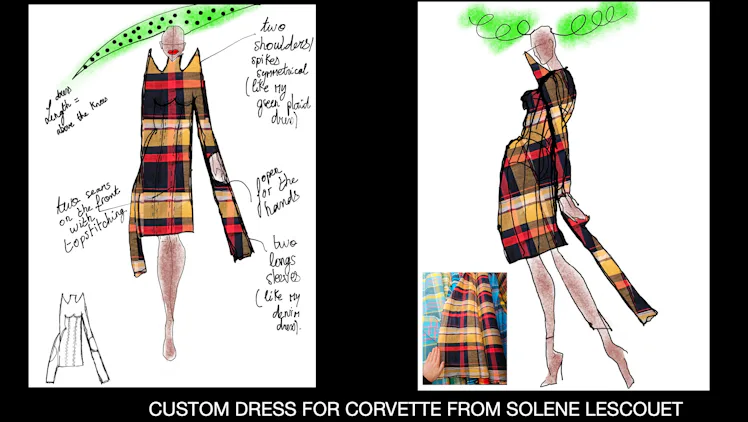
What were the main goals Boots expressed about how the fashion should look? Was he pretty specific or was he open to your collaboration?
He was open to my collaboration. He sent some visual reference boards for how some of the sets would look, but he left it open to me to come up with the costumes and the ideas for that. I knew it was important to work in line with the production designer because we needed to lock down the specific shades of each of the sets.
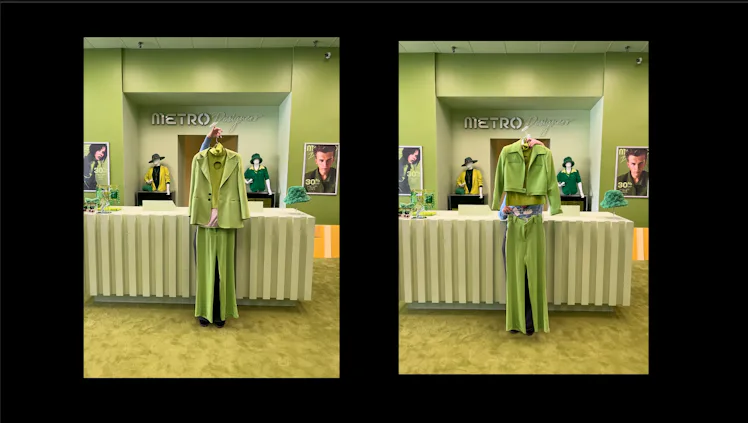
Early on, [Christopher Glass, production designer] had shipped out the color swatches, but he painted a big board. That was helpful, because working off a little Pantone chip is hard. When pulling, I would hold it up against it and be like, “OK, yeah, this shade of yellow works or this shade of green does not work.” I definitely involved a lot of trial and error of working out because at first you're like, “No, it’s yellow. It should be fine.” But then you’re like, “Oh my God, there are so many different shades.” And same with the greens. It was a fine line of veering too blue, or too dark, or too light. It was a lot of experimentation.
When they’re boosting together, there’s that great montage with a lot of different outfits. I feel like that was a chance for you to have some fun and let your creativity reign. As a fashion lover, that was one of my favorite parts of the movie.
Yeah, same with me.
I'm curious if you had a favorite, and also where you drew inspiration for those specific moments.
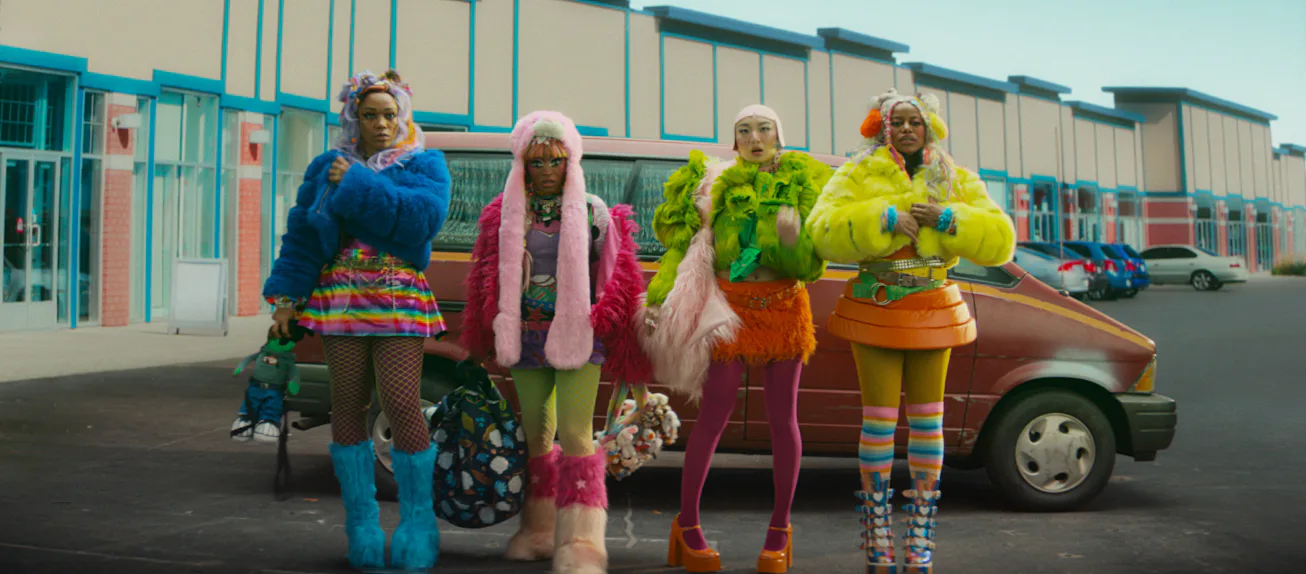
That whole montage scene was my favorite part of the film in terms of finding costumes. It was kind of loose because Boots didn’t have specific things in the script, so we had to spitball ideas. We had a whole list and unfortunately we didn’t have the time to shoot all of them, but we got the main ones in. Boots would suggest ideas and I was like, “OK, love that. That’s doable.” He came up with the decades, each girl representing the ‘50s, ‘60s, ‘70s, ‘80s, which was so much fun. I suggested florals because then we could go crazy with that, and that’s something I could easily source or get made. I also thought it would be fun to have a cool menswear look for them, and I always love a good raver, Harajuku moment because Fruits is my Bible. That book is something I reference constantly through the years. I really wanted to do a Fruits inspired look for all of them.
Did you pull any inspiration from Oakland style to dress them?
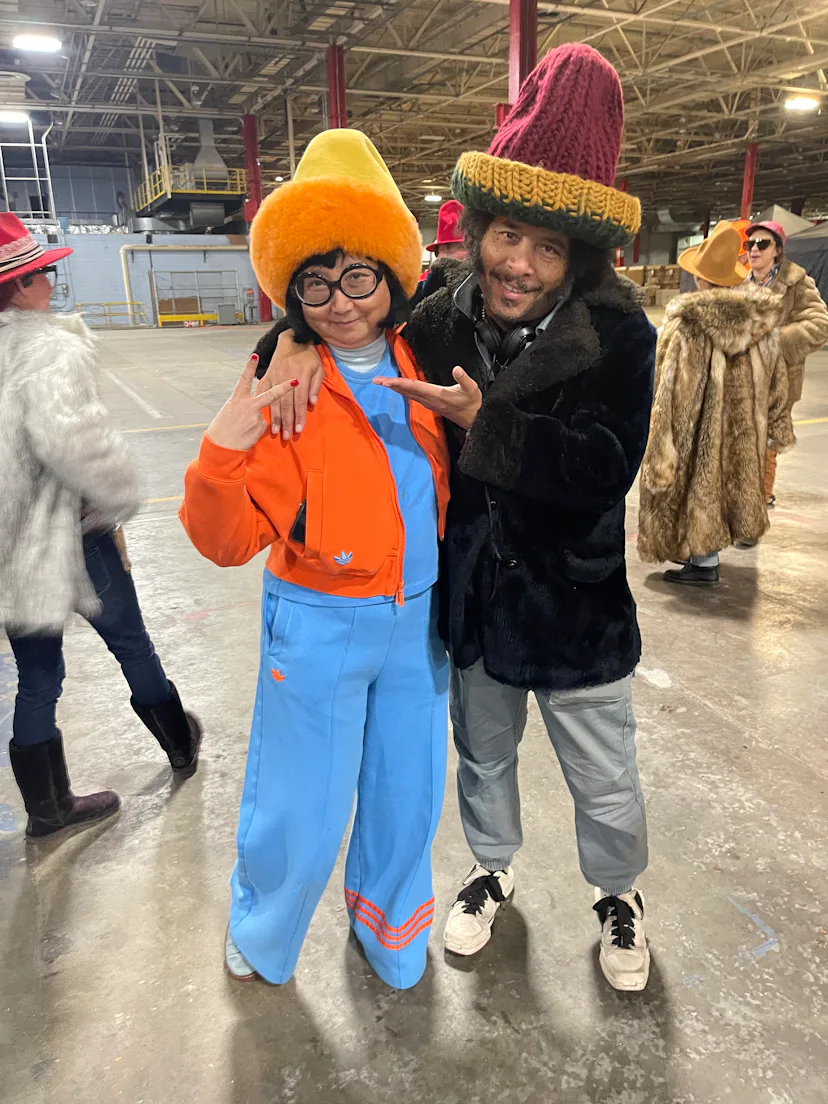
I wanted to add elements where you felt like it was Oakland. So I had a jacket that had the colors of the Oakland A’s. I studied creatives in Oakland, and there’s an art sensibility, but there’s some quirkiness and a cool mixing of colors and textures. I wanted to embrace that artist community and how they dress. That's pretty much Boots’ world too. The way he dresses is very unique, with his tall hats and everything. I wanted to reflect that sort of cool, funky energy.
What was the hardest challenge you experienced on set?
There were things I had gotten that I was like, “Oh, this would be great.” We had the sets because they were built, and I would hold up the outfit and then photograph it, and what I thought like, “Oh my God, this would look so great on the set,” and then it didn’t. There was that need to hold it up and see what pops and what looks cohesive in that environment.

What references or inspiration did you use for LaKeith Stanfield’s character?
With LaKeith, I don’t even think I had any visual boards. I just went to the costume house and pulled looks that might be interesting. I had a purple high-waisted zoot suit I had used on a music video and I was like, “This seems kind of cool,” or these ‘80s pleated trousers seemed kind of cool. I think the only indication in the script was that he was wearing turquoise for one of the scenes. I just felt, especially because he's reading books in cafes, maybe an element of a scholar, so we put him in suits.
I just pulled a bunch of things, and then when LaKeith came to the fitting, we experimented and tried to come up with the character. Sometimes the process works like that, where I’m not sure. You could put a potato sack on him and he’d probably make it look cool. We worked out what pieces worked the best for him, and knowing he was a model on the runway show, found pieces that were bright and colorful to fit into the palette of Christie Smith's world.

How much planning went into the final runway scene? I'm curious if you even know a number of how many costumes you had that day.
There must have been at least 150 to 200 extras that we dressed, and everyone does not have these bright colors in their closet. We shopped racks and racks of pieces in those colors. It was a lot of thrifting and online shopping. We had to shop off-brand or at those suit stores that cater to the church crowd and they would have suits in bright colors, but tons of thrifting.
What did you learn about costuming from doing this movie, and what do you hope the audience takes away from the movie about fashion?
For me, working on a project like this is important, where it does showcase fun fashion and costume design, but it also tells a message. It’s an important message about fast fashion, the environment, and the exploitation of workers creating the clothes. I want the viewers to understand that it's not just a fashion film, it's deeper than that, and to be left with that idea of art is important. It's also something that can save humanity, but we also have to be responsible about how we do it, and how we treat each other.
I Love Boosters is now playing in theaters nationwide.
